

Summary
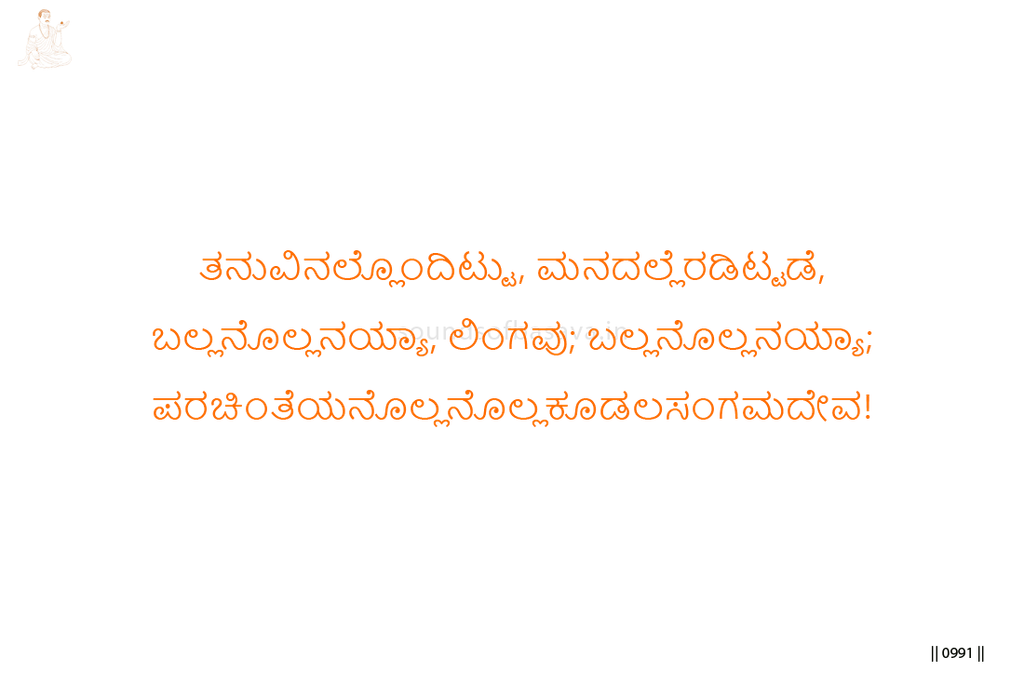
Basavanna teaches that strength belongs to undivided being. If the body is placed in one direction and the mind in another, there is no true strength. Life becomes weakened because it is split within itself.
The same teaching is then applied to Linga. If Linga is held as one thing while the seeker thinks from another center, the relation has not become whole. The source states that the deeper division is between the self and the Linga, and that regarding the Divine as separate sustains duality and prevents realization.
The final line rejects para-chinte, the thought of another or the imagination of separateness. Before Kudalasangama Deva, the seeker cannot live with one body, another mind, and a Linga held apart. Strength is the steadiness that comes when body, mind, and Linga are no longer divided.
Imagery & Symbolic Relevance
The first image is the body placed in one way. The body represents lived action and outward conduct. Basavanna begins with the visible field of life: what the seeker does, where the body moves, and how life is carried.
The second image is the mind placed in another way. The mind represents inward intention, thought, and orientation. When the mind is elsewhere while the body acts outwardly, life becomes divided.
The question “is there strength?” gives the first judgment of the vachana. Strength here is not physical force. The Aikya source explains it as inner coherence. Where body and mind move apart, energy is dispersed and clarity is weakened.
The line “does Linga have strength?” deepens the teaching. Basavanna is not saying that Linga lacks power. He is asking whether the seeker’s relation to Linga can stand strong when the seeker remains divided within himself.
The Linga is the center before which division is tested. If the body moves one way, the mind another, and Linga is kept as a separate sacred object, the relation has not become whole. Linga cannot be treated as an external support while the inner life remains split.
The phrase “para-chinte” gives the root of the fracture. Para-chinte means the thought of another, the mind’s creation of a second center. The source explains it as the imagination of separation, where the mind creates “I” and “That” as divided realities.
The repeated rejection — “not that, not that” — shows firmness. Basavanna does not allow divided thought to remain as harmless. To think from separateness after turning toward Linga weakens the very ground of practice.
The final address to Kudalasangama Deva gathers the whole teaching. Body must not go one way while mind goes another. Mind must not imagine another center apart from Linga. The seeker must stand before Kudalasangama Deva without inward division.
Together, the lines show that true strength is indivisibility. Action, mind, and Linga-relation must not remain separate fields. When division ends, strength is not forced; it is the natural steadiness of undivided awareness.
Lingayoga
In Lingayoga, this vachana teaches the discipline of inner and outer alignment. The seeker must examine whether bodily conduct and inward thought stand together before Linga.
The practice-point is direct: do not allow the body to perform one direction while the mind holds another. Do not allow Linga to become an object held apart from life. Do not allow para-chinte, the thought of another center, to govern awareness.
The Aikya source states that wholeness is not constructed; it is uncovered when division ends. Therefore the relevance of this vachana is the removal of split living before Kudalasangama Deva.
Editorial Commentary
This vachana should be read as a strict teaching on indivisibility, not as a general moral statement. Basavanna’s concern is the fracture between body, mind, and Linga. Where the body acts, the mind must not stand elsewhere. Where Linga is known, the mind must not create another center.
The word “strength” should remain close to the vachana. It is not muscular strength, social strength, or argumentative strength. It is the strength of one-pointed, undivided being before Kudalasangama Deva.
Related Vachana
Supporting Vachana
Sharana Sthala Vachana 1382 — When Word, Mind, and Deed Become One
In that vachana, Basavanna warns against saying “Linga, Linga” with the mouth while the mind remains false and the body does not follow truth. The source states that mind, word, and body must become one, and that Kudalasangama Deva is pleased only where inner intention, spoken word, and lived conduct arise from one truth.
This directly prepares Aikya Vachana 95. Sharana Vachana 1382 demands that sacred speech, mind, and bodily conduct become one. Aikya Vachana 95 carries the same demand further inward: body and mind must not be divided, and the mind must not create a second center apart from Linga.
Advancing Vachana
Aikya Sthala Vachana 146 — The Arrow from the Divine Bow
Aikya Vachana 146 advances this teaching within Aikya Sthala itself. In Vachana 95, Basavanna teaches that strength lies in indivisibility: body, mind, and Linga-relation must not be split. In Vachana 146, that indivisibility becomes action without personal division. The source states that devotion is no longer held as an idea; the sense of doership falls away, action is not owned, and what moves is already of Kudalasangama Deva.
Thus Vachana 95 establishes the strength of undivided being, while Vachana 146 shows that strength in motion. When body, mind, and Linga are no longer divided, action no longer returns to self-claim. It moves like the arrow released from the Divine bow.
