

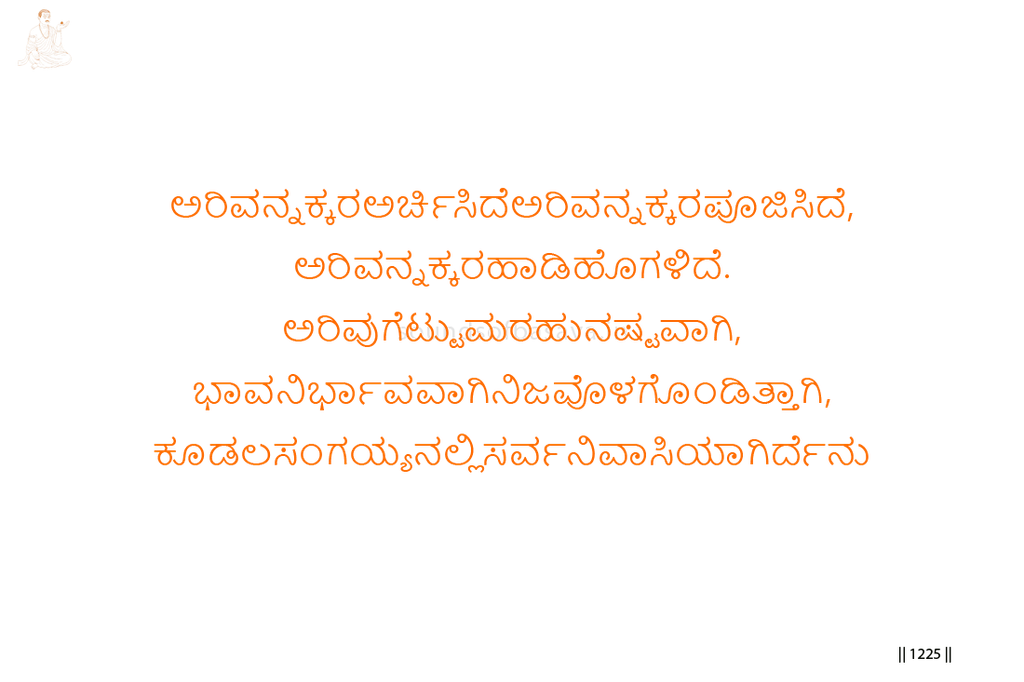
Summary
Basavanna worships the Knower: he offers worship, performs pūjā, sings, and praises.
Through this complete devotional turning, ordinary knowing comes to an end and forgetfulness is destroyed. Bhāva becomes nirbhāva, and truth becomes inwardly established.
In Kudalasangamayya, Basavanna becomes sarvanivāsi—one whose abiding is no longer confined to a separate personal centre.
Imagery & Symbolic Relevance
The vachana contains no natural or household comparison. Its imagery is formed through two carefully ordered sequences: acts of worship followed by the cessation of inward distinctions.
The first statement is “I worshipped the Knower.”
The source-expression is repeated three times. This repetition establishes the Knower as the sole focus of Basavanna’s devotional movement.
The first verb is archiside—I offered worship or reverentially honoured.
The second is pūjiside—I performed pūjā.
Although the two words are related, the vachana preserves both. Reverential offering and formal worship are not compressed into one general statement.
The third movement joins song and praise.
Basavanna says that he sang and extolled the Knower. Voice now joins offering and worship. The movement includes action, ritual honour, song, and spoken praise.
The threefold repetition gives a complete devotional orientation:
worshipping the Knower;
performing pūjā to the Knower;
singing and praising the Knower.
The vachana then turns sharply from worship to inward transformation.
Knowing comes to an end.
The Knower has been worshipped, but knowing is no longer retained as a personal possession. Basavanna does not conclude, “Therefore I now possess complete knowledge.”
The structure moves in the opposite direction. The worship of the Knower brings the claim and operation of separate knowing to its limit.
Next, forgetfulness is destroyed.
Knowing and forgetting ordinarily form a pair. Something is known, retained, obscured, or forgotten. When knowing ends but forgetfulness also disappears, neither member of this mental opposition remains as the governing condition.
The next transformation is bhāva becoming nirbhāva.
Bhāva includes inward feeling, disposition, formation, or the condition through which the devotee relates to what is worshipped.
Nirbhāva indicates freedom from that formed condition. The source does not say merely that one emotion is replaced by another. The very field of formed bhāva becomes nirbhāva.
The following phrase brings the movement into nija—truth or the real.
The condition becomes gathered within truth, or truth becomes its inward ground. Basavanna no longer describes himself through worship, knowing, forgetfulness, or devotional formation.
The culmination is sarvanivāsi.
Nivāsi is one who dwells or abides. Sarva gives the sense of all or everywhere.
Basavanna says that he became sarvanivāsi in Kudalasangamayya. Kudalasangamayya remains the governing field of the statement.
The phrase does not establish Basavanna as an independently all-pervading being. His all-abiding condition exists only in Kudalasangamayya.
The complete sequence is therefore:
the Knower is worshipped;
the Knower is honoured through pūjā;
the Knower is sung and praised;
knowing comes to an end;
forgetfulness is destroyed;
bhāva becomes nirbhāva;
truth becomes the inward ground;
and Basavanna becomes sarvanivāsi in Kudalasangamayya.
Lingayoga
In Lingayoga, worship begins through conscious relation: the practitioner offers, performs pūjā, sings, praises, remembers, and seeks to understand.
The vachana shows the maturation of these acts. Worship does not culminate in the claim, “I have become the knower.” The claim of possessing knowledge itself falls away.
Forgetfulness also loses its authority. The practitioner is no longer moving repeatedly between knowing and losing what was known.
When bhāva becomes nirbhāva, devotion is no longer maintained as a personal emotional state. It becomes settled abidance whose ground is Kudalasangamayya.
The practical movement is therefore from worship directed toward the Knower into an abiding where knowing, forgetting, and self-owned devotional formation no longer divide the relation with Linga.
Editorial Commentary
The repeated source-expression rendered as “the Knower” should remain open. The Kannada does not explicitly identify a named Sharana or replace the expression with a separate philosophical definition.
Archiside means worshipped, reverentially honoured, or offered worship.
Pūjiside means performed pūjā or worshipped through sacred observance.
Hāḍi hogaḷide means sang and praised.
Arivu-geṭṭu indicates that knowing ended, failed, or lost its separate operation. It should not be interpreted as ordinary intellectual impairment.
Marahu naṣṭavāgi means that forgetfulness was destroyed or disappeared.
Bhāva nirbhāvavāgi means that bhāva became nirbhāva. The paired terms should be retained because the transformation itself is central.
Nija means truth, the real, or the true condition.
Sarvanivāsi means one who dwells in all, everywhere, or as all-abiding. The grammatical ground remains Kudalasangamayya: Basavanna becomes sarvanivāsi in Him.
Related Vachana
Supporting Vachana
Sharana Sthala Vachana 1047 — The Knower of All States
Sharana Vachana 1047 presents Maḍivāḷa Machayya as one who knows the gathered range of states, while Basavanna refuses to claim such knowledge for himself.
It prepares Vachana 1013 through reverence toward the one who knows. In Sharana Sthala, Basavanna stands humbly before realized knowing; in Aikya Vachana 1013, he worships the Knower until even the distinction created by separate knowing disappears.
What begins as reverence for the knower therefore culminates in the ending of personal knowledge, the destruction of forgetfulness, and entry into truth within Kudalasangamayya.
Advancing Vachana
Aikya Sthala Vachana 1242 — Beyond the “I” Before the Linga
Vachana 1013 states that Basavanna becomes sarvanivāsi in Kudalasangamayya after knowing, forgetfulness, and formed bhāva have ceased to govern.
Vachana 1242 advances this by asking where the separate “I” can remain before the Mahatma called Linga. It clarifies that the Sharana may continue to bear a body, yet is not therefore ordinary or inwardly separate from the natural Divine condition.
Thus the all-abiding condition of Vachana 1013 is deepened in Vachana 1242: embodied life may remain, while the separate claimant has no independent place before Linga.
