

Summary
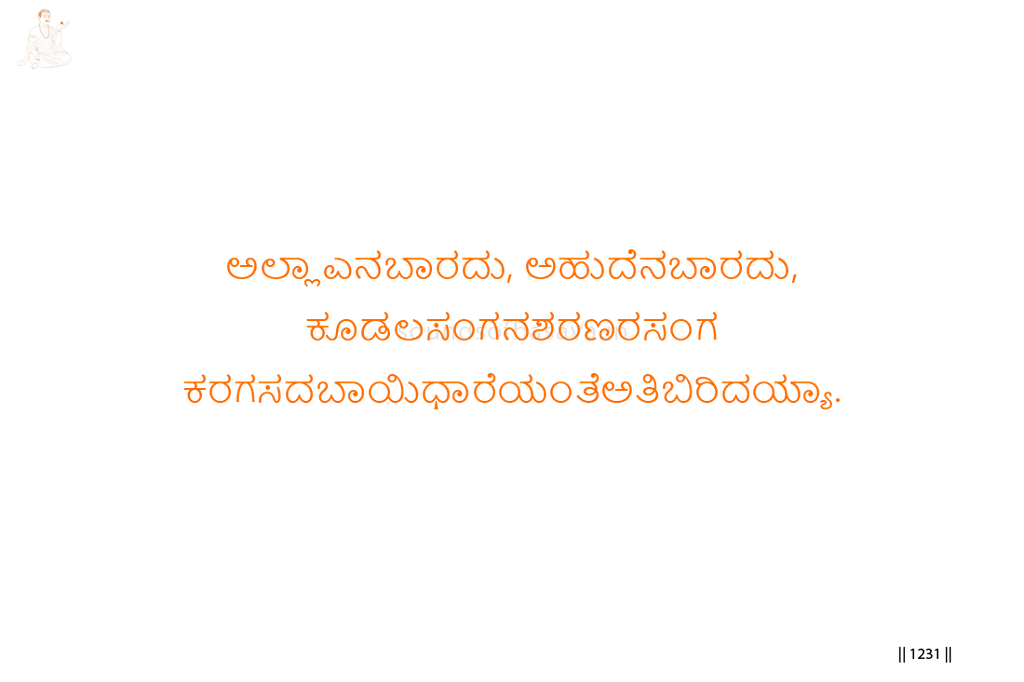
Basavanna asks the reader not to confine truth within the two fixed conclusions, “It is not” and “It is.”
The vachana is not promoting indecision. It points to the fellowship of Kudalasangama Deva’s Sharanas as a lived reality too vast to be contained by affirmation or denial.
Their fellowship is compared to the broad, toothed mouth of a saw. Just as its edge spreads across many teeth rather than ending in one narrow point, Sharana-sanga cannot be reduced to a single judgment or definition. It must be entered and experienced rather than settled through argument.
Imagery & Symbolic Relevance
The first instruction is, “Do not say, ‘It is not.’”
Absolute denial closes the matter before it has been understood. The mind may reject what it cannot measure, explain, or fit within familiar ideas. Basavanna does not permit such denial to become the final judgment upon the Sharanas’ fellowship.
The second instruction is, “Do not say, ‘It is.’”
Affirmation can also become limiting when the mind assumes that it has completely defined what is present. To say, “It is exactly this,” may reduce living experience to a fixed conclusion.
Basavanna therefore refuses both extremes. “It is not” excludes; “It is” confines. Neither can contain the full reality of Sharana-sanga.
The focus then shifts directly to the fellowship of Kudalasangama Deva’s Sharanas. This is important because the vachana is not discussing abstract reasoning alone. It concerns a living community formed through devotion, conduct, experience, and belonging to the Lord.
The word sanga indicates company, fellowship, and shared spiritual relation. Such fellowship cannot be known only by observing it from outside. Its depth becomes clear through participation in the life and experience of the Sharanas.
The saw provides the vachana’s central concrete image. Its mouth or cutting edge is formed by many teeth spread across a broad line. It is not gathered into one smooth or narrow point.
Basavanna uses this breadth to describe Sharana-sanga. The Sharanas cannot be compressed into one opinion, appearance, definition, or philosophical position. Their fellowship is wider than the mind’s opposing conclusions.
The image should remain connected to breadth rather than expanded into unrelated symbolism. The vachana says that the fellowship is “very wide.” Its purpose is to show that the field of the Sharanas exceeds narrow judgment.
The complete movement is therefore direct: denial is refused, fixed affirmation is refused, and the reader is pointed toward the vast living fellowship of Kudalasangama Deva’s Sharanas.
Lingayoga
In Lingayoga, the seeker must avoid making quick conclusions about spiritual experience, the Linga, or the condition of the Sharanas.
This does not remove practical discernment. It asks the seeker not to mistake a mental conclusion for complete realization. What is known only through argument must ripen into lived experience.
Sharana-sanga becomes essential because it moves the seeker beyond private opinion. In the company of the Sharanas, truth is encountered through conduct, devotion, service, and Anubhava rather than through “yes” or “no” alone.
Editorial Commentary
The commands “Do not say it is not” and “Do not say it is” do not prohibit ordinary speech or responsible judgment. They reject the use of affirmation and denial as final containers for realized truth.
The Kannada image should remain concrete: the fellowship is compared to the broad mouth or toothed edge of a saw.
The teaching concerns neither doubt nor indecision. It concerns a reality too broad to be exhausted by opposing statements.
Related Vachana
Supporting Vachana
Sharana Sthala Vachana 1331 — Gather What Has Been Deposited in the Eternal Treasury
Sharana Vachana 1331 distinguishes between possessing many sacred words and allowing those words to become lived truth. A large treasury of vachanas remains incomplete when it is not gathered into life. Speech alone may continue like sound before an unmoved mountain.
This prepares Vachana 1025 directly.
In Sharana Vachana 1331, the seeker is warned not to confuse accumulated words with realization. The value of the vachanas lies in their becoming conduct and experience.
Vachana 1025 takes the next step. Even the opposing verbal conclusions “It is” and “It is not” cannot contain the fellowship of the Sharanas. What Sharana Sthala asks to be gathered into life is recognized in Aikya as wider than conceptual judgment.
Thus stored speech gives way to lived Sharana-sanga.
Advancing Vachana
Aikya Sthala Vachana 1357 — Beyond Attachment and Detachment
Vachana 1025 refuses to define the Sharanas’ fellowship through “It is” or “It is not.”
Vachana 1357 carries this teaching into the actual conduct of the realized Sharana. Even scholars and masters of the Agamas cannot finally declare, “This is what he is.” Kudalasangama Deva’s Sharana is neither attached nor detached.
The continuation is precise. Vachana 1025 removes the mind’s broadest opposing conclusions—affirmation and denial. Vachana 1357 shows the same freedom in a specific pair of judgments: attachment and detachment.
The Sharana acts from inward alignment and cannot be confined to either category. What is first taught as freedom beyond “yes” and “no” becomes lived freedom beyond clinging and renunciation.
