

Summary
Basavanna describes three aspects of spiritual life becoming firmly established within him.
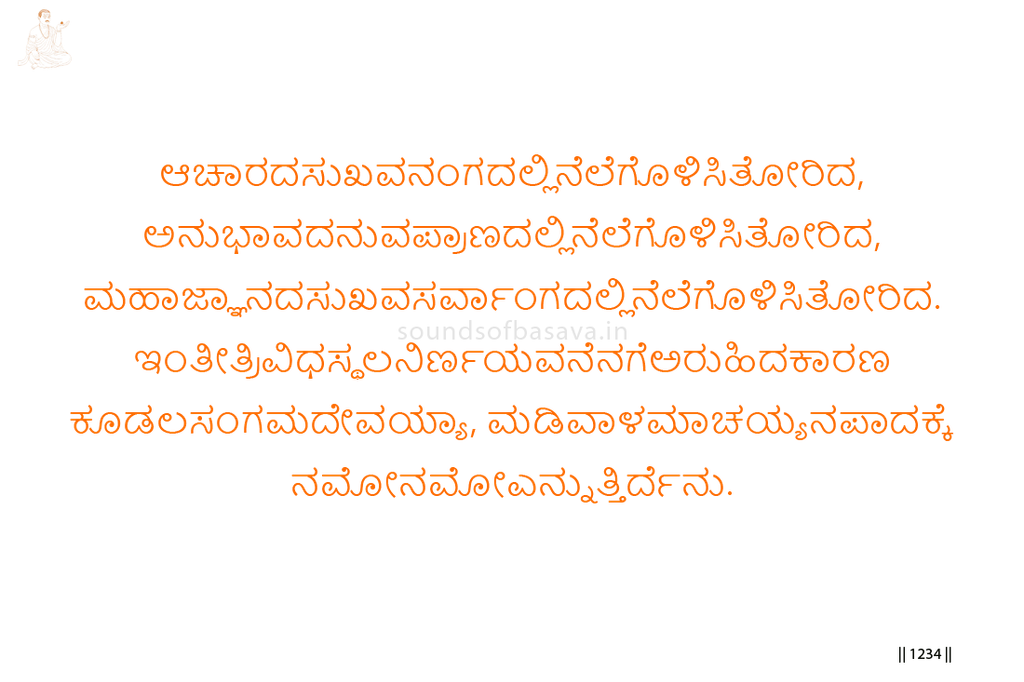
The joy of Achara, right conduct, is established in the Anga, the embodied person. Anubhava, direct spiritual experience, is established in the Prana, the living breath and life-force. The joy of Mahajnana, great knowledge, spreads through the Sarvanga, the whole being.
These are not merely ideas that Basavanna has learned. They have become part of how he acts, lives, and knows.
He receives this threefold discernment through Madivala Machayya. Therefore, before Kudalasangama Deva, he repeatedly bows at Machayya’s feet in gratitude.
Imagery & Symbolic Relevance
The vachana is built upon three parallel movements:
Achara established in Anga
Anubhava established in Prana
Mahajnana established in Sarvanga
Each movement uses the expression “established and shown.” This indicates that the teaching has not remained verbal. It has been made steady and visible in life.
The first movement concerns the joy of Achara.
Achara is right conduct—the way sacred understanding is expressed through daily behaviour. When it is established in the Anga, the body no longer acts separately from spiritual understanding.
Basavanna calls this the “joy” of Achara. Right conduct is therefore not presented as a burden imposed from outside. When conduct becomes natural and inwardly accepted, it brings steadiness and happiness.
The Anga is the embodied person. It includes the body as the field of action. Establishing Achara in the Anga means that devotion is visible in how one lives, works, speaks, serves, and relates to others.
The second movement concerns Anubhava established in the Prana.
Anubhava is direct experience. It is not information heard from another person, nor an idea remembered from scripture. It is truth personally lived and known.
Prana is the life-force expressed through breath and living presence. By placing Anubhava in Prana, the vachana shows that experience has entered life itself. It is no longer occasional or dependent on a special moment.
The person does not merely remember a past spiritual experience. Anubhava remains alive in the very movement of life.
The third movement concerns the joy of Mahajnana established throughout the Sarvanga.
Mahajnana is not ordinary learning or the possession of many spiritual ideas. It is great knowledge that has become direct clarity.
Sarvanga means the whole being. The knowledge is therefore not confined to the intellect. It fills conduct, awareness, breath, feeling, and action.
The three movements show an increasing fullness. Achara is established in embodied action. Anubhava reaches the life-force. Mahajnana pervades the entire being.
Yet these should not be treated as three unrelated achievements. Conduct prepares life for experience; experience deepens into knowledge; knowledge then fills the whole person.
Basavanna calls this trividha-sthala-nirnaya, the discernment or clear understanding of the threefold state.
The word nirnaya indicates settled recognition. Basavanna has not merely been given three definitions. He has been shown how the three become established within lived existence.
The closing movement turns from the threefold teaching to Madivala Machayya.
Basavanna does not claim, “I established these conditions through my own effort.” He remembers the one through whom their meaning was revealed and bows at his feet.
The feet signify the lived ground of the Sharana’s teaching. Bowing there means accepting not only Machayya’s words but the path demonstrated through his life.
The repeated “Namo, Namo” expresses continuing gratitude. A single formal salutation is not enough. Basavanna lives in remembrance of the grace received through Madivala Machayya.
The complete movement is therefore from conduct in the body, to experience in the life-force, to knowledge throughout the whole being, and finally to gratitude at the feet of the Sharana who revealed this threefold establishment.
Lingayoga
In Lingayoga, conduct, experience, and knowledge must support one another.
Right conduct should become visible through the body and daily life. Direct experience should become steady within the breath and living awareness. Knowledge should influence the whole person rather than remain in thought alone.
The vachana also teaches humility. Spiritual growth is not to be claimed as an individual achievement. The seeker should recognize the role of Guru and Sharana and remain grateful for the guidance through which understanding became life.
Editorial Commentary
Achara-sukha means the joy arising from right and settled conduct. It should not be reduced to obedience to external rules.
Anubhava means direct lived experience, while Prana indicates living breath or life-force. The line therefore presents experience as established in life itself.
Mahajnana is great or complete knowledge, and Sarvanga means the entire being. The knowledge is not confined to the mind.
Madivala Machayya must remain central to the conclusion. Basavanna’s repeated bowing is directed to his feet because the threefold discernment was revealed through him.
Related Vachana
Supporting Vachana
Sharana Sthala Vachana 989 — Purified Through the Company of Sharanas
In Sharana Vachana 989, Basavanna admits that he did not possess Dasoha and Bhakti as living realities. When he examined himself, he found nothing that he could claim as spiritual worth.
He then states that he became purified through contact with Kudalasangama Deva’s Sharanas. With the Lord as witness, he lives saying “Namo, Namo” at the feet of Madivala Machitande.
This prepares Vachana 1034 very closely.
Vachana 989 shows the beginning of transformation through Sharana-sanga. Basavanna does not purify himself; the presence and influence of the Sharanas reshape him.
Vachana 1034 shows the fuller result of that transformation. Achara is now established in the Anga, Anubhava in the Prana, and Mahajnana throughout the entire being.
Both vachanas end in repeated reverence at Madivala Machayya’s feet. In Sharana Sthala, Basavanna is purified through the Sharana’s touch. In Aikya Sthala, that purification has matured into complete establishment of conduct, experience, and knowledge.
Advancing Vachana
Aikya Sthala Vachana 1084 — The Revelation Within the Karasthala
In Vachana 1084, Basavanna beholds Allama Prabhu, Chennabasavanna, and Madivala Machideva within the Karasthala-Linga held in his palm.
As this vision unfolds, the distinction between inner and outer disappears. Basavanna says that Kudalasangama Deva’s Sharanas have purified him, and he again responds with “Namo, Namo.”
This provides a specific continuation of Vachana 1034.
In Vachana 1034, the grace received through Madivala Machayya establishes Achara, Anubhava, and Mahajnana within body, life-force, and the whole being.
In Vachana 1084, that inward establishment becomes direct Karasthala vision. Madivala Machideva and the other great Sharanas are no longer experienced as merely external teachers; they are beheld within Linga itself.
The threefold establishment therefore advances into vision without inner–outer division. Gratitude remains the final response in both vachanas: “Namo, Namo” before the Sharanas through whom Kudalasangama Deva’s grace became known.
