

Summary
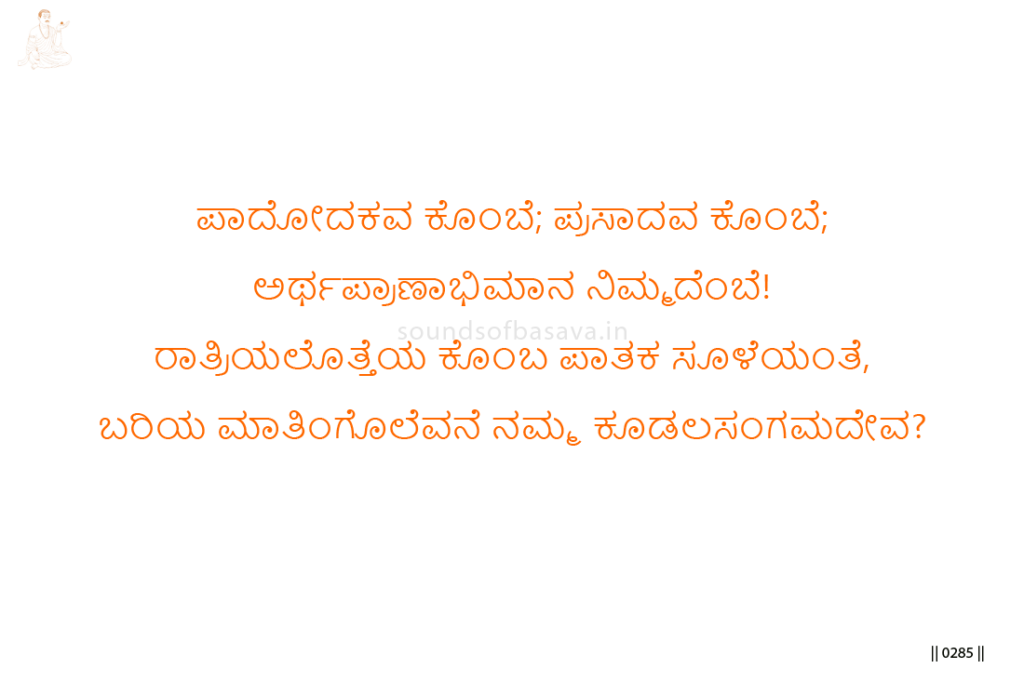
In this vachana, Basavanna examines the gap between sacred claim and hidden conduct. One may say, “I receive pādodaka. I receive prasāda. My meaning, life-breath, and self-regard are Yours.”
Yet if the inner life turns away when unseen, the claim becomes hollow. Sacred reception has not become continuous awareness.
Basavanna asks whether Kudalasangama Deva can be pleased by mere words. The teaching is clear: pādodaka and prasāda must be lived inwardly, not only received outwardly.
Imagery & Symbolic Relevance
The first image is pādodaka. It signifies sacred reception and the claim of having received grace.
The second image is prasāda. It is not merely something taken; it must become assimilated into the seeker’s way of living.
The third image is artha, prāṇa, and abhimāna. Wealth or meaning, life-breath, and self-regard are declared to belong to Kudalasangama Deva. The claim is total.
The fourth image is the hidden turn at night. This shows the concealed field where truth is tested. When no one sees, the seeker’s real continuity is revealed.
The fifth image is mere speech. Words may declare surrender, but speech alone cannot please Kudalasangama Deva if life does not agree with it.
Together, these images show the test of continuity. What is received as pādodaka and prasāda must not remain external. What is declared as belonging to Kudalasangama Deva must remain so in hidden conduct also.
Lingayoga
In Lingayoga, this vachana tests whether sacred reception has become steady awareness. The seeker must not receive pādodaka and prasāda outwardly while inward life turns elsewhere.
The whole field of life must be offered: meaning, life-breath, and self-regard. If these are only spoken as belonging to Kudalasangama Deva, but not lived as such, practice remains incomplete.
The practical movement here is inward continuity. Devotion must remain true when unseen, not only in the visible act of worship.
Editorial Commentary
This vachana should be read as a warning against devotional speech without continuity. Basavanna is not questioning the value of pādodaka or prasāda. He is asking whether they have truly entered the seeker’s life.
The night-image is important because it tests what remains when public form is absent. If the seeker’s hidden conduct contradicts the words of surrender, the words become bare speech.
Basavanna therefore places the whole person before Kudalasangama Deva. Sacred reception must become lived truth, or it remains incomplete.
Related Vachana
Supporting Vachana
Bhakta Sthala Vachana 300 — Forging the Unbreakable Vessel
Bhakta Sthala Vachana 300 supports this vachana by praying for freedom from deceit in body, mind, and wealth. Vachana 469 carries the same demand into Maheshwara Sthala: one may say that artha, prāṇa, and abhimāna belong to Kudalasangama Deva, but the hidden life must also remain free from deceit.
Advancing Vachana
Prasadi Sthala Vachana 787 — The Sacred Morsel
Prasadi Sthala Vachana 787 advances this movement by showing sacred reception becoming continuous remembrance. Vachana 469 warns that pādodaka and prasāda must not remain mere claims. Vachana 787 carries this into Prasadi Sthala, where even each morsel received after Linga-offering is joined to remembrance, and awareness does not break before Kudalasangama Deva.
