Poetic Rendering
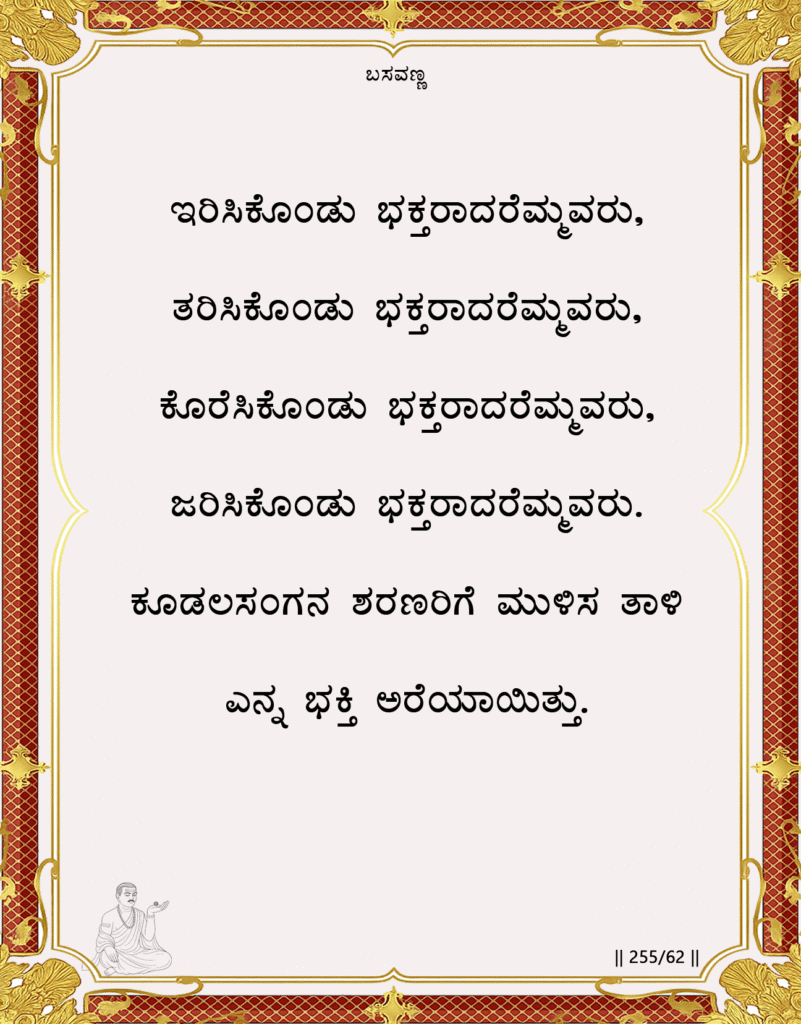
Some flaunt it
for the world to see.
Some wear the Linga
because they were told to,
others because they were scolded into it.
But to wear it
without inner fire
like a marriage thread without love
is devotion left unfinished,
O Koodalasangamadeva.
Basavanna distinguishes between true, heartfelt devotion and devotion adopted out of pressure, habit, or display. Without inner commitment, the outward symbol of worship remains incomplete.
Spiritual Context
Core Spiritual Principle: The efficacy of a spiritual practice is determined by the authenticity and depth of the practitioner’s inner intention (bhavana). Outer form without inner substance is a hollow shell that cannot convey grace.
Cosmic Reality Perspective: The Divine (Linga) is the knower of the heart (Sarvajna). It responds to the genuine vibration of love and surrender, not to the external configuration of symbols or rituals. A practice performed without feeling is like tuning an instrument without the intent to make music; it produces no resonance in the cosmic reality.
Historical Reality (Anubhava Mantapa Context): As the Lingayat path grew, Basavanna saw the danger of it becoming another empty ritualistic tradition. This Vachana is a crucial internal critique, a warning against spiritual complacency and hypocrisy. It ensures that the revolutionary spirit of the movement is not lost to social conformity, peer pressure, or the mere performance of piety. It calls for a faith that is a living, personal commitment, not a social inheritance.
Interpretation
1. “Some flaunt it for the world to see.” This describes devotion rooted in ego and the desire for social recognition (loka drishti). The spiritual symbol is used as a badge of identity or superiority, which utterly contradicts its purpose of fostering humility.
2. “Some wear the Linga because they were told to, others because they were scolded into it.” This addresses devotion born of external pressure from family, community, or fear of reprimand. This is devotion based on obedience or fear, not on understanding or love. It is fragile and lacks the power to transform the individual.
3. “But to wear it without inner fire like a marriage thread without love is devotion left unfinished…” This is the core teaching. The “inner fire” (tapas) represents the heat of genuine longing, love, and personal conviction. The powerful analogy of the “marriage thread without love” illustrates a form that is devoid of its essential, life giving content. Such devotion is “unfinished” because it has not accomplished its primary purpose: to forge a living, loving connection between the soul and the Divine.
Practical Implications: The seeker is guided to: Regularly examine their motives for spiritual practice. Is it from the heart, or from habit, fear, or a desire for approval? Cultivate a personal, heartfelt relationship with the Divine that is independent of social validation. Understand that the value of a ritual lies in its ability to focus and express inner devotion, not to replace it.
The Cosmic Reality
Anga (Human Dimension): The Anga is the individual whose inner state aligns with their outer practice. Their wearing of the Linga is a true reflection of an internal commitment, a heart ignited with the “inner fire” of devotion.
Linga (Divine Principle): The Linga is the divine reality that can only be truly “worn” or internalized through sincere love and surrender. It responds to authenticity, not to empty gestures.
Jangama (Dynamic Interaction): The Jangama is the spirit of the tradition the living transmission of faith from one sincere heart to another. It is the opposite of the external pressures listed; it is the inner call that inspires genuine practice. The dynamic interaction is the congruence between one’s inner feeling and outer action.
Shata Sthala
Primary Sthala: Bhakta Sthala. This Vachana addresses the very first requirement of a true devotee: sincerity (shraddha). Without this, one cannot genuinely enter the path, let alone progress through the other stages.
Supporting Sthala: The principle of authenticity is the golden thread that runs through all stages. In Maheshwara Sthala, the renunciation must be genuine, not a performance. In Prasadi Sthala, the reception of grace requires an authentically open heart. In Aikya Sthala, the seeker becomes the embodiment of this authenticity.
Practical Integration
Arivu (Awareness Practices): Heart Motivation Check: Before any spiritual practice (wearing the Linga, prayer, etc.), pause and connect with the feeling behind the action. Let the action be an expression of that feeling.
Contemplation on Sincerity: Reflect on the difference between performing an action for an external audience (other people) and an internal audience (your own conscience and the Divine).
Achara (Personal Discipline): Make sincerity your primary discipline. Strive for your outer actions to be a truthful reflection of your inner state.
Kayaka (Sacred Action): Perform your work with genuine engagement and integrity. Avoid “quiet quitting” or doing the bare minimum for show; let your work be a true offering of your capability.
Dasoha (Communal Offering): Help foster a community environment where people feel safe to be spiritually authentic, without pressure to conform to a certain image of piety.
Modern Application
“Spiritual Consumerism and Performative Piety.” In the age of social media, spirituality can become a curated performance. People adopt practices for their aesthetic appeal or to signal virtue to their peers, leading to a culture of inauthenticity where the inner dimension is neglected.
The Liberative Application: This Vachana is a powerful call to spiritual authenticity. It liberates the seeker from the pressure to maintain a spiritual “image” and encourages a private, heartfelt relationship with the sacred. It validates the journey of the individual who may not perform external rituals perfectly but whose heart is full of genuine love and seeking.
Essence
A symbol worn for the eyes of the crowd
is a jewel that weighs the spirit down.
A practice born of another’s command
is a song sung in a forgotten tongue.
But the Linga worn with a fire within
is a bridge the soul can walk upon.
This Vachana establishes a critical principle in the metaphysics of spiritual practice: the outer form (bahiranga) is a container for the inner essence (antarang). The essence is the transformative agent. Its multidimensional impact is to ensure that the Lingayat path remains a living spirituality (anubhava) rather than decaying into a dead ritualism (karma kanda). It positions the Jangama as the guardian of this living spirit, the one who transmits not just the form of the practice, but the fire of authentic devotion that gives it life and meaning.
In any spiritual or meaningful endeavor, the “why” is far more important than the “what.” A simple, sincere prayer from the heart is infinitely more powerful than the most elaborate ritual performed without feeling. True devotion is not something you show the world; it is a private fire that illuminates your soul from within. Never let your practice become a hollow shell. Always tend the inner flame.

Views: 1