

Summary
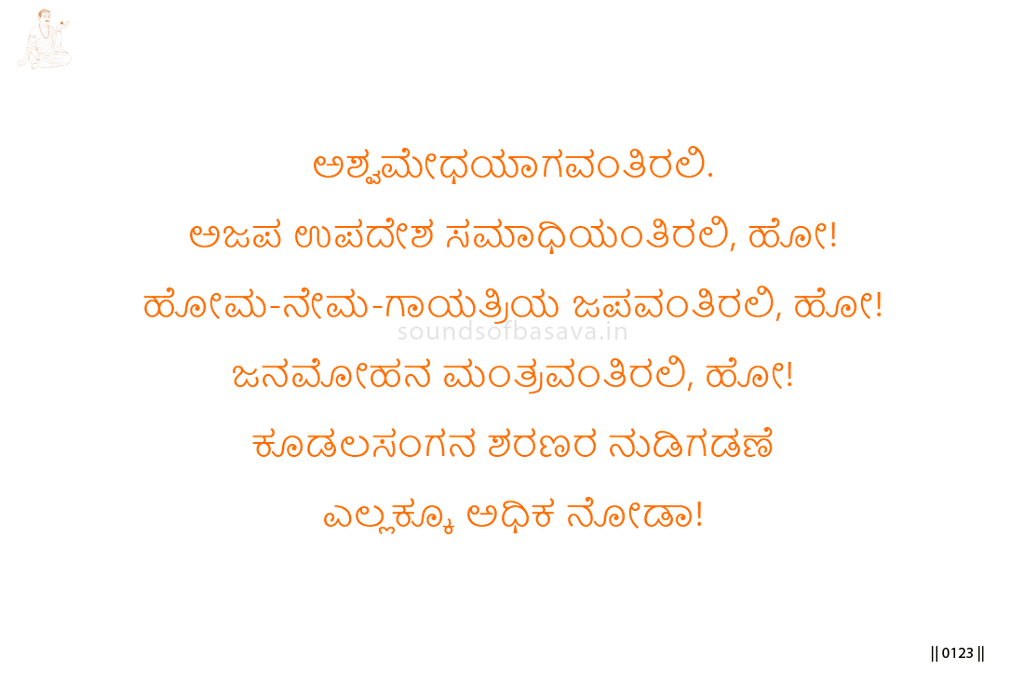
In this vachana, Basavanna places highly regarded religious and contemplative practices beside the word of Kudalasangama’s Sharanas.
He names Ashvamedha-yaga, Ajapa Upadesha, Samadhi, Homa, Nema, Gayatri-japa, and Janamohana-mantra. Yet his conclusion is clear: the word of Kudalasangama’s Sharanas surpasses them all.
The distinction is between spiritual performance and lived realization. Ritual, mantra, discipline, and meditation may have their place, but the Sharana speaks from Anubhava—truth already assimilated into awareness and life.
The vachana therefore places realized experience above spiritual accomplishment.
Imagery & Symbolic Relevance
Ashvamedha-yaga represents the grandeur and prestige of elaborate sacrificial practice.
Ajapa Upadesha and Samadhi move the comparison inward, representing subtle instruction and contemplative absorption.
Homa, Nema, and Gayatri-japa stand for disciplined observance, sacred offering, and repeated mantra.
Janamohana-mantra represents extraordinary mantraic power or the capacity to influence others.
By bringing all these together, Basavanna covers a wide range of spiritual accomplishment—from outward ritual to inward meditation and extraordinary power.
The repeated “ಹೋ!” strengthens the comparison, allowing each practice to stand before the final declaration.
The decisive phrase is:
“ಕೂಡಲಸಂಗನ ಶರಣರ ನುಡಿಗಡಣೆ ಎಲ್ಲಕ್ಕೂ ಅಧಿಕ”
The ನುಡಿಗಡಣೆ of the Sharanas is not ordinary speech. Its authority comes from the realization behind it. The Sharana speaks what has been tested through devotion, conduct, surrender, and Anubhava.
Basavanna therefore shifts the measure from what one performs or possesses to the truth one has actually become capable of living and expressing.
Lingayoga
In Lingayoga, every discipline must ultimately deepen the relation between Anga and Linga.
The body may perform Homa, the tongue may repeat mantra, the mind may enter meditation, and the seeker may receive Upadesha. These become spiritually fruitful when they transform awareness rather than remain separate accomplishments.
The Sharana’s word carries special significance because it arises from living Linga-sambandha. When received rightly, it can awaken the listener’s own inward movement.
The progression is:
hearing → Arivu → assimilation → Achara → Anubhava.
What is heard must become understanding; understanding must enter conduct; and conduct must ripen into lived realization.
The vachana therefore prevents Lingayoga from becoming technique alone. Its concern is not how advanced a practice appears, but whether Anga is actually being transformed in relation to Linga.
Editorial Commentary
This vachana establishes Anubhava as the final measure of spiritual worth.
Basavanna does not need to dismiss Yaga, Japa, Homa, Nema, Upadesha, or Samadhi. His comparison asks a deeper question: what have these practices produced in the person?
A ritual can be completed without inward change.
A mantra can be repeated without awakening.
Instruction can be heard without being assimilated.
Spiritual power can arise without freedom from self-claim.
The word of the true Sharana has another authority because it comes from realization already embodied in life.
This is particularly important in Bhakta Sthala. The seeker is being taught not to mistake grandeur, learning, technique, or extraordinary capacity for spiritual maturity. Basavanna directs the Bhakta toward the living testimony of the Sharanas.
The teaching is direct:
The greatness of a spiritual path is revealed not by the magnificence of its practice, but by the realization it brings forth.
Bhakta Vachana 599 — The Heart’s Measure
Vachana 599 asks what value there is in Veda, Shastra, Japa, Tapas, or other spiritual practices if Kudalasangama Deva has not touched the heart.It supports the present vachana by establishing the same measure: outer or disciplined practice must reach the inner being.The present vachana carries this further by placing the Anubhava-born word of the Sharanas above practices that have not yet become lived truth.
Advancing Vachana
Maheshwara Vachana 586 — The Chant That Never Lands
The present vachana teaches the value of the realized word. Maheshwara Vachana 586 advances the movement by asking whether what is heard and repeated has actually become steady discipline.The transition is therefore:
receiving the realized word → assimilating it → preserving it through Achara → living it before Kudalasangama Deva.What Bhakta first recognizes as authoritative truth, Maheshwara must make visible in conduct.
Note:
This Vachana was found repeated in the reference work Samanyarigagi Basava Vachana. To avoid duplication, Vachana 617 has been replaced here. Supporting or Advancing linkage has been assigned to this revised Vachana. While maintaining the earlier connectivity for the seeker referred below.
Related Vachana
Supporting Vachana
Bhakta Vachana 612 — Beyond Scripture: The Open Path of Realization
Bhakta Vachana 612 supports this vachana by teaching that scriptural learning, poetry, song, and recitation are not the final measure of spiritual greatness. The true measure is the attainment lived by Kudalasangama Deva’s Sharanas. Vachana 617 continues that same teaching through the images of unused water, unused gold, and untasted sky-fruit: without Sharana-Anubhava, apparent value does not become realized truth.
Advancing Vachana
Maheshwara Vachana 860 — The Dream that Masquerades as Realization
Vachana 617 teaches that without the Anubhava of Kudalasangama Deva’s Sharanas, place, condition, and outward value have no final worth. Maheshwara Vachana 860 advances this into a sharper Maheshwara-stage warning: deluded Shivachara may appear real like a dream, but those still bound in bhava cannot know the Anubhava of the Sharanas. What appears here as unrealized value becomes, in Maheshwara Sthala, the direct distinction between appearance and lived realization.
