

Summary
In this vachana, Basavanna speaks of the unavoidable condition of sustaining the body.
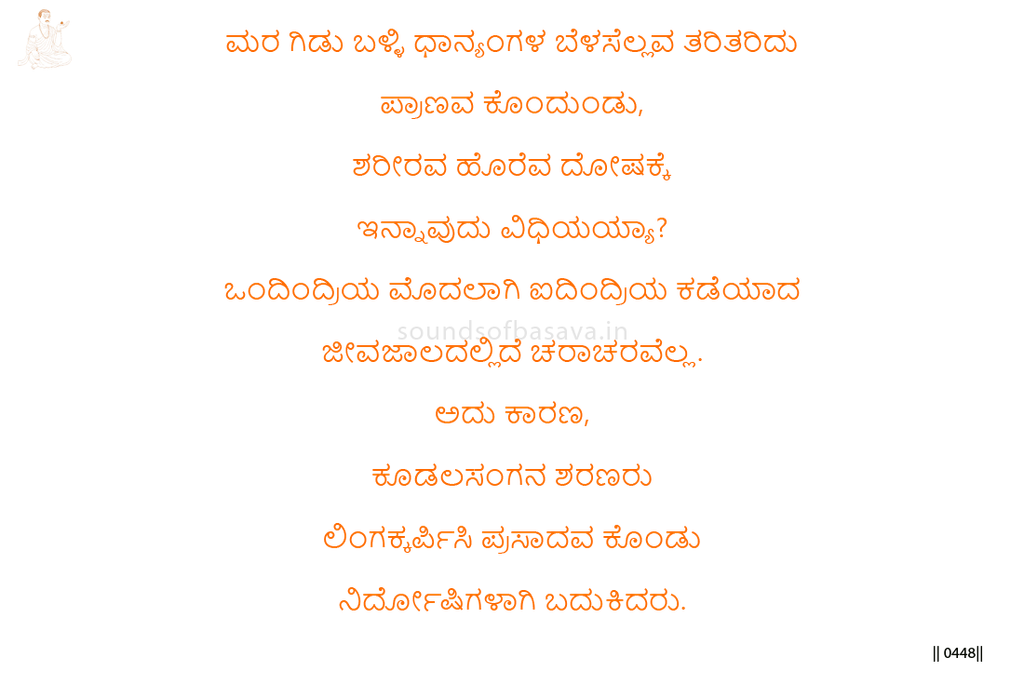
Trees, plants, creepers, grains, and crops are cut; their life is taken, and the body is maintained. Basavanna asks what other rule or way has been given for this fault of sustaining the body.
He then widens the field. From one-sensed beings to five-sensed beings, all moving and unmoving life exists within the living world.
For this reason, the Sharanas of Kudalasanga recognized the all-pervading Linga within and in Jangama. They first offered to Linga, received as Prasada, and lived without blame.
The teaching is direct: embodied life involves taking life for sustenance. The Sharana’s way is not careless consumption. It is recognition of Linga, offering to Linga, receiving as Prasada, and living without blame.
Imagery & Symbolic Relevance
The first image is trees, plants, creepers, grains, and crops. Basavanna names the life forms that become food for maintaining the body.
The second image is cutting and taking life. He does not hide the action. Even plant life is counted as life, and sustaining the body carries a fault when it is done as direct consumption.
The question “What other way has been given?” shows the practical difficulty of embodied life. The body must be sustained, yet the act of sustaining it cannot be treated as free from consequence when it is governed by possession or appetite.
The next image is the range from one-sensed to five-sensed beings. This shows that the living world includes many forms of life, both moving and unmoving.
The final image is the conduct of Kudalasanga’s Sharanas. They do not merely eat what is available. They recognize Linga within life and in Jangama, offer first to Linga, receive as Prasada, and thereby live as nirdoshi — without blame.
Lingayoga
In Lingayoga, this vachana teaches that bodily sustenance must be brought into the relation of Linga and Jangama.
Food is not to be taken as personal possession or mere bodily right. It must first be related to the all-pervading Linga, offered to Linga, and then received as Prasada.
For Prasadi Sthala, the point is exact: Prasada is the way by which necessary eating becomes sacred receiving. The Sharanas live without blame because they do not consume independently; they receive only after offering to Linga.
Editorial Commentary
“One-sensed to five-sensed beings” should be retained because it shows the range of life within the living world.
The phrase “fault of sustaining the body” should not be softened. Basavanna is naming the moral and spiritual difficulty of embodied living.
The solution is also explicit. The Sharanas of Kudalasanga recognize Linga, offer to Linga, receive as Prasada, and therefore live without blame.
Related Vachana
Supporting Vachana
Maheshwara Sthala Vachana 577 — In the Name of Sacrifice
Maheshwara Vachana 577 supports this vachana by warning that killing and eating cannot be made sacred merely by giving them a ritual name.
In Vachana 1308, Basavanna also faces the problem of taking life for food, but gives the Sharana way: first offer to Linga, then receive as Prasada. Both vachanas refuse careless consumption under sacred language.
Advancing Vachana
Pranalingi Sthala Vachana 1272 — Established in Prāṇa-Linga
Pranalingi Vachana 1272 advances this teaching by showing a mature life in which nothing is touched unless it has first been offered to Linga, and life abides in Prasada.
In Vachana 1308, the Sharanas live without blame by recognizing Linga, offering to Linga, and receiving as Prasada. In Vachana 1272, this becomes continuous Pranalingi discipline: every act of touching, receiving, and using is governed by prior offering and life in Prasada before Kudalasangama Deva.
