

Summary
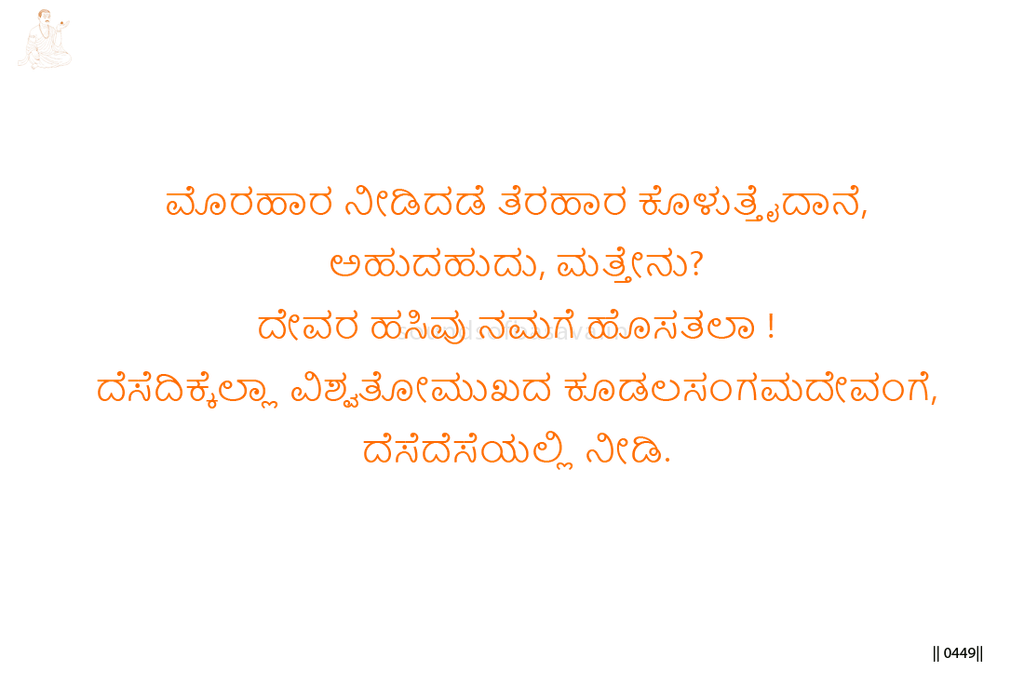
In this vachana, Basavanna uses the image of a due or tax. When a due is to be paid, one pays it. There is no need for further argument.
He then asks, “Is God’s hunger new to us?” The hunger of Deva is not something unknown or unexpected. It is already part of the sacred demand placed before the devotee.
Kudalasangama Deva is described as Vishvatomukha, the One whose face is turned toward all directions. Therefore Basavanna says to give in every direction.
The teaching is direct: giving is not to be treated as an occasional favour or selective generosity. Since Kudalasangama Deva faces every direction, the response must also move in every direction.
Imagery & Symbolic Relevance
The first image is the payment of a due. A due is not paid after long hesitation or self-praise. It is paid because it is owed. Basavanna uses this image to show that giving belongs to the devotee’s obligation before the Lord.
The second image is God’s hunger. Basavanna does not present this hunger as strange or new. The devotee should already know that the Lord’s hunger calls for response.
The third image is Vishvatomukha Kudalasangama Deva. Vishvatomukha means the One whose face is everywhere or turned toward all directions. This prevents the devotee from confining the Lord to one place or one chosen recipient.
The final instruction is to give in every direction. The direction may change, but the Lord faced there is Kudalasangama Deva. Giving therefore becomes a response to the all-facing presence of the Lord.
Lingayoga
In Lingayoga, this vachana teaches that giving must arise from recognition of Kudalasangama Deva’s all-facing presence.
The seeker should not wait for giving to become emotionally convenient. When the due appears, it must be given.
For Prasadi Sthala, the point is exact: what is received through grace must move outward as rightful giving. The Prasadi does not hold grace as private possession, but lets it move toward Kudalasangama Deva in every direction.
Editorial Commentary
The image of tax or due should be kept simple. Its force lies in obligation: what is due should not be withheld.
“God’s hunger” should not be reduced to ordinary bodily hunger alone. In the vachana, it names the sacred call to give.
“Vishvatomukha” should be retained. It explains why the instruction is not to give only in one place, but in every direction.
Related Vachana
Supporting Vachana
Maheshwara Sthala Vachana 421 — Water the Root, and the Tree Blossoms
Maheshwara Vachana 421 supports this vachana by teaching that Jangama is the mouth of Linga and that offering reaches its proper living point there.
In Vachana 1324, Kudalasangama Deva is Vishvatomukha and the devotee is told to give in every direction. Maheshwara Vachana 421 clarifies how such giving remains sacredly directed: what is offered to the living mouth of Linga reaches the Lord and is not mere scattered charity.
Advancing Vachana
Pranalingi Sthala Vachana 759 — The Living Kayaka
Pranalingi Vachana 759 advances this teaching by showing the Bhakta who does and gives as a hidden treasure, and the Padodaka-Prasada-jivi as one whose life is sustained by sacred receiving and offering.
In Vachana 1324, giving is made a due before Vishvatomukha Kudalasangama Deva. In Vachana 759, this advances into Pranalingi living: action, giving, receiving Padodaka and Prasada, and moving among others are freed from self-seeking and become the living presence of Kudalasangayya.
