

Summary
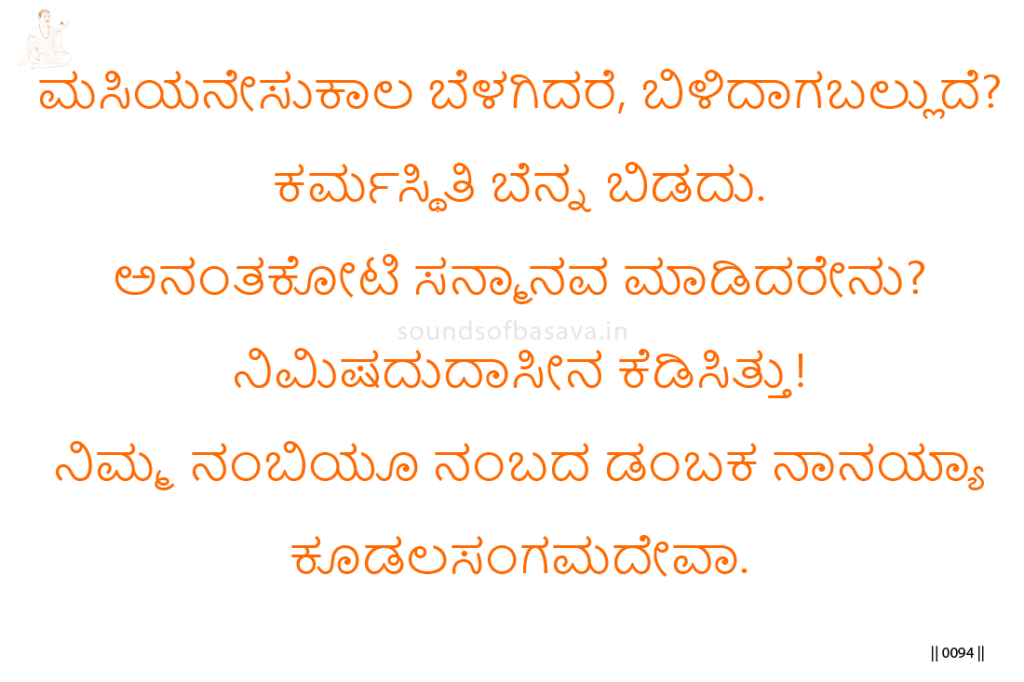
In this vachana, Basavanna speaks of a stain that does not easily leave.
If something has been blackened for a long time, can it become white merely by washing? In the same way, the condition formed by karma does not fall away through outward correction alone.
He then asks what use there is in countless honors if one moment of indifference destroys the inner ground. Basavanna ends by confessing that he is a hypocrite who trusts and yet does not truly trust Kudalasangama Deva. The vachana exposes the danger of divided faith.
Imagery & Symbolic Relevance
The blackened cloth is the first image. It suggests something deeply marked, not lightly soiled.
Washing represents outward correction, ritual effort, or repeated attempts to appear clean. Such washing may touch the surface, but it cannot by itself remove what has entered deeply.
Basavanna applies this to karma. The state produced by action does not leave easily. It clings, follows, and shapes the seeker’s condition.
Countless honors form the second contrast. Public respect, praise, or religious recognition may accumulate in great measure, but they cannot protect the seeker from inner negligence.
A single moment of indifference becomes decisive. It shows how quickly devotion can be weakened when awareness turns away from truth.
The final confession gives the vachana its force. Basavanna names the divided condition plainly: he trusts Kudalasangama Deva, and yet he does not fully trust. This is the hypocrisy of a heart that has not become whole.
Lingayoga
In Lingayoga, practice must enter deeper than outer cleansing.
The Anga may perform worship, receive honor, and appear aligned, but karmic tendencies may still remain within.
The danger is not only visible wrongdoing. Even a moment of inward indifference can loosen the thread of remembrance.
Trust must therefore become steady. The seeker must move from occasional faith to an undivided relation with Linga.
Practice matures when the stain is not merely covered, but exposed and purified before Kudalasangama Deva.
Editorial Commentary
This vachana warns against mistaking appearance for cleansing.
Basavanna shows that honor, repetition, and outward correction cannot heal the divided heart unless trust becomes whole.
Related Vachana
Supporting Vachana
Vachana 376 — The Living Spring of Sacred Company
Vachana 376 shows the Sharanas as water, sight, and treasure. Vachana 383 continues by warning that even after receiving sacred influence, the seeker must face the stain that cannot be removed by outer contact alone.
Advancing Vachana
Maheshwara Vachana 485 — The Battle for Inner Sovereignty
Vachana 383 confesses divided trust before Kudalasangama Deva. Maheshwara Vachana 485 advances this into the clearer recognition that the seeker has begun the path, but has not yet reached completion.
