

Summary
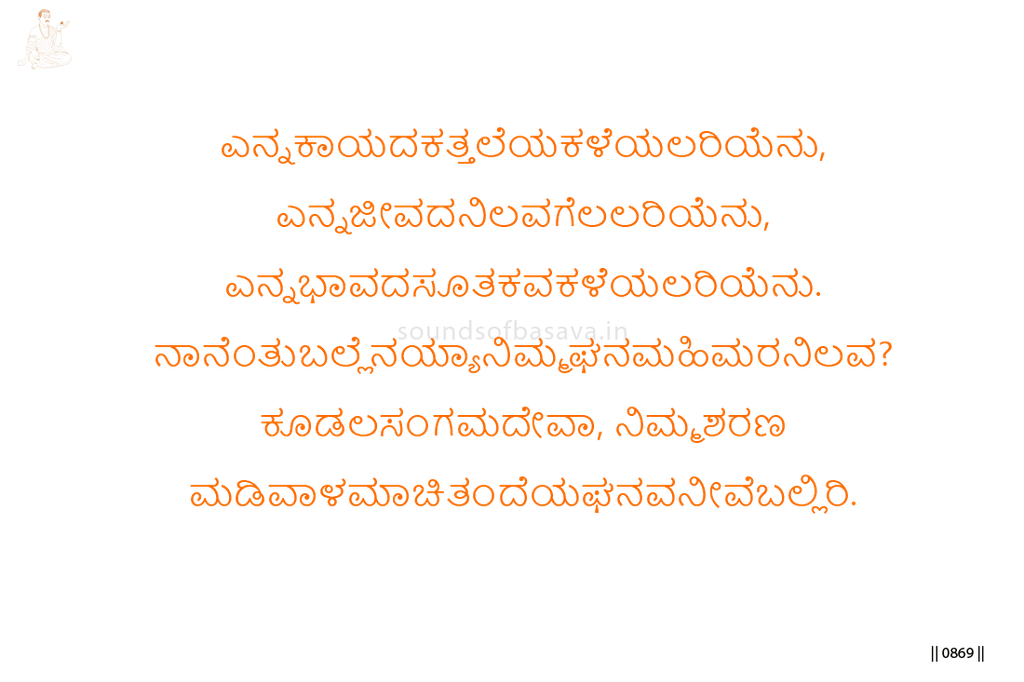
Basavanna confesses the limit of his own strength. He cannot dispel the darkness of the body, cannot secure the true state of life, and cannot remove the impurity hidden within bhava. These repeated confessions do not express despair. They mark the end of self-reliance.
The question “What strength have I?” brings the vachana to its center. The seeker cannot measure or attain the boundless greatness of Kudalasangama Deva through personal power. The greatness before him exceeds his capacity.
The vachana then turns toward Madivala Machideva. Basavanna does not claim to know the greatness of this Sharana. He says that Kudalasangama Deva alone knows it. The true stature of a realized Sharana cannot be measured by ordinary understanding.
Thus the vachana holds two humilities together: humility before one’s own incapacity and humility before the immeasurable greatness of the Lord’s Sharana. What the seeker cannot remove, secure, or measure must be left to Kudalasangama Deva, who alone knows the depth of grace and realization.
Imagery & Symbolic Relevance
The first image is the darkness of the body. The body carries limitation, obscuration, and mortality. Basavanna does not say that he has mastered this darkness. He admits that he cannot dispel it by himself.
The second image is the true state of life. Life moves, feels, acts, and seeks, but its true standing cannot be secured by the life-force alone. Basavanna recognizes that the stability of realized life cannot be produced by personal effort.
The third image is the impurity of bhava. This is subtler than bodily darkness. It points to the stain hidden within becoming, feeling, identity, and inner formation. Basavanna says he cannot remove this impurity by his own strength.
The repeated “I cannot” gives the vachana its rhythm. Each confession removes another basis for spiritual pride. The body cannot be purified by self-confidence. Life cannot be stabilized by self-assertion. Bhava cannot be cleansed by the one still caught within it.
The next image is the boundless greatness of Kudalasangama Deva. Basavanna asks what strength he has to attain its measure. The answer is implied: none. Divine greatness is not an object that the seeker can weigh, reach, or possess.
The final image is Madivala Machideva’s greatness. Basavanna does not attempt to describe it fully. He leaves it with Kudalasangama Deva. This restraint is important. The realized Sharana’s true greatness is known by the Lord, not by external measurement.
Lingayoga
In Lingayoga, this vachana teaches the failure of self-sufficient effort. The seeker may practice, examine, and strive, but the deepest darkness, instability, and impurity cannot be removed by self-claim.
For Sharana Sthala, the practice-point is direct: confess the limit of personal strength without falling into despair. Let the confession become refuge. The one who says “I cannot” has stopped pretending to be the source of purification.
This also shapes the relation to the realized Sharana. Madivala Machideva is not to be measured by ordinary understanding. His greatness belongs to Kudalasangama Deva’s knowing. The seeker’s proper response is humility, reverence, and surrender.
Editorial Commentary
The threefold confession should remain central: body’s darkness, life’s true state, and bhava’s impurity. The vachana should not be turned into general self-negation. Its force lies in the precise recognition that what the seeker cannot purify or measure is known and completed only through Kudalasangama Deva’s grace.
Related Vachana
Supporting Vachana
Pranalingi Sthala Vachana 1005 — Through the Tears of Rudra
Pranalingi Vachana 1005 supports this teaching by showing the sacred means through which bondage and impurity are overcome. There, through Rudrākṣi, bhava-pāśa is cut, body-bound tendencies are broken, Mahāmāyā is overcome, grave impurity is removed, and all duritas are conquered. This prepares Vachana 1082 directly. In Vachana 1005, the bonds of becoming, bodily limitation, illusion, and impurity are overcome through a grace-bearing sacred means; in Vachana 1082, Basavanna confesses that he cannot remove the darkness of body, secure the true state of life, or cleanse bhava’s impurity by his own strength.
Advancing Vachana
Aikya Sthala Vachana 1083 — The Day the Darkness Broke
Aikya Vachana 1083 advances this teaching by showing the very transformation that Vachana 1082 says cannot be achieved by personal power. There, the darkness of the body is shattered, the greed for body, mind, and possessions falls away, and the ego is dissolved through Chennabasavanna’s grace. This is the natural Aikya fulfillment of Vachana 1082. In Sharana Vachana 1082, Basavanna says he cannot dispel darkness, secure the true state, or remove impurity by himself; in Aikya Vachana 1083, those obscurations break through grace, and the contentment of Kudalasangama Deva is revealed.
