

Summary
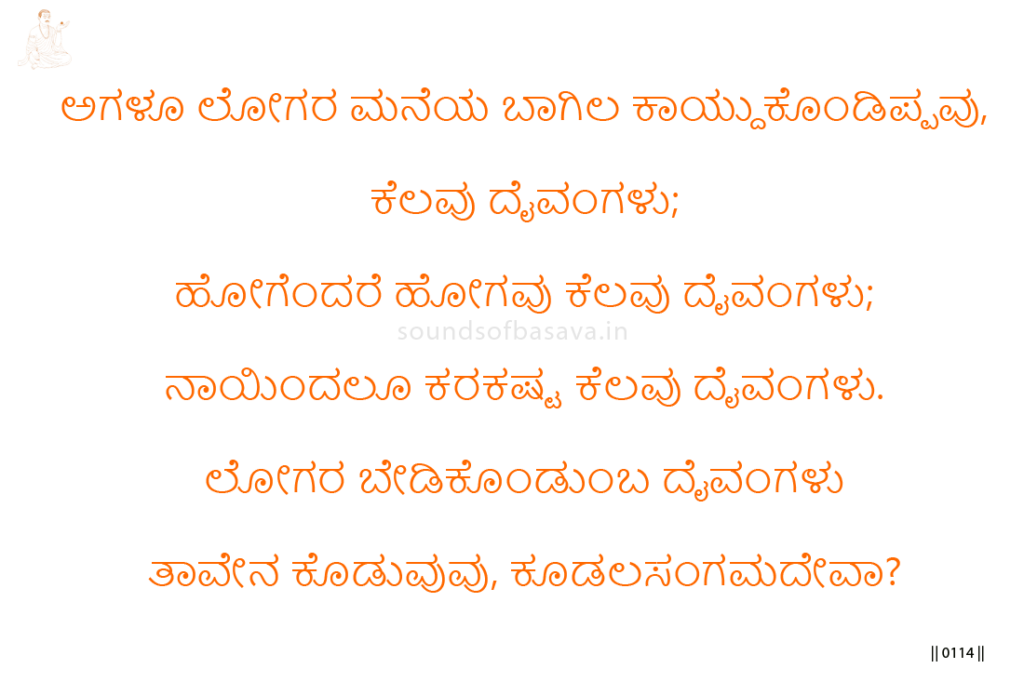
In this vachana, Basavanna questions gods who depend on those who worship them.
Some stand at the doors of people’s houses. Some go when they are told to go. Some are more helpless than dogs. Some live by receiving what people give them.
Basavanna asks: what can such gods truly give? The vachana turns the seeker away from dependent powers and toward Kudalasangama Deva, the true source of giving.
Imagery & Symbolic Relevance
The gods standing at people’s doors form the first image. They appear stationed at thresholds, waiting upon human households.
The gods who go when told to go form the second image. They are not shown as sovereign; they respond like dependents.
The comparison to dogs sharpens the critique. Basavanna shows that such gods lack true freedom and authority.
The gods who live by begging or receiving from people form the final image. They are sustained by those who serve them.
These images expose the contradiction. If a deity must wait, obey, and receive, how can it be the true giver?
Basavanna’s question directs the seeker toward discernment. The one who depends on human maintenance cannot be the final refuge.
Lingayoga
In Lingayoga, the seeker must discern the source of devotion.
The Anga may be drawn toward forms that promise help, protection, or worldly benefit. But if those forms are themselves dependent, they cannot lead the seeker to the highest truth.
Kudalasangama Deva is not a power maintained by transaction. He is the source before whom all bargaining falls away.
Practice matures when devotion turns from dependent forms toward the living source of grace.
Editorial Commentary
This vachana distinguishes the true giver from dependent objects of worship.
Basavanna asks the seeker to examine whether what is worshipped is sustained by people or is itself the source of sustenance.
Related Vachana
Supporting Vachana
Vachana 526 — The Seed, the Tree, and the Infinite Gardener
Vachana 526 shows Kudalasangama Deva receiving the ripened fruit of the path. Vachana 554 continues by contrasting Him with dependent gods who wait, obey, and receive from others.
Advancing Vachana
Maheshwara Vachana 668 — The Wavering Mind and the Weightless Devotion
Vachana 554 asks what dependent gods can truly give. Maheshwara Vachana 668 advances this into unflinching witness, where discernment must remain steady before appearances and turn only toward Kudalasangama Deva.
