
The Sixfold Path
Shatsthala presents the spiritual movement through Bhakta, Maheshwara, Prasadi, Pranalingi, Sharana, and Aikya.
The six Sthalas are not ranks, honours, or permanent identities. They describe the changing relation of Anga with Linga as devotion awakens, enters conduct, becomes receptive to Prasada, settles within Prana and daily life, matures in surrender and service, and reaches fulfilment in non-separation.
The Vachanas selected below introduce the distinctive character of each Sthala. They are not intended to exhaust its meaning; the complete Vachana collections develop each movement in full.
The Six Sthalas at a Glance
Bhakta — Divine nearness is recognised and remembrance awakens.
Maheshwara — Bhakti becomes Achara and is tested in conduct.
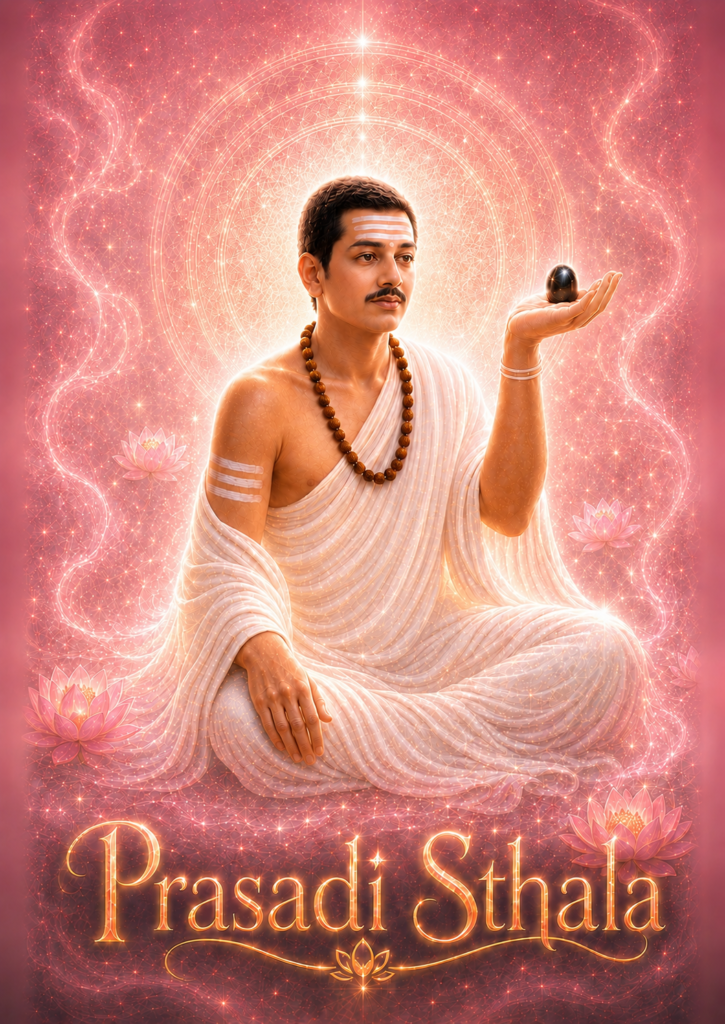
Prasadi — grace is received without bargain or possession.
Pranalingi — Linga-awareness enters Prana and the whole of daily life.
Sharana — inward realisation becomes surrender, service and Dasoha.
Aikya — the remaining divisions of Anga and Linga, giver and receiver, knower and known cease to stand as independent finalities.
BHAKTA STHALA

Awakening to Divine Nearness
Bhakta Sthala begins with the awakening of Bhakti. Kudalasangama Deva is recognised not merely as a distant object of worship, but as a presence already near. Remembrance begins to interrupt forgetfulness; bondage becomes visible; the mind is examined; and devotion is tested by whether sacred relation becomes inwardly real.
Vachana 1 — The Hidden Fire
Fire hidden in water, taste within sap, fragrance within dew, and love not yet spoken express a presence that exists before it becomes outwardly visible.
Kudalasangama Deva is presented as already near. Bhakti begins with recognition of this concealed presence rather than with the creation of something absent.
Vachana 6 — The Unshakeable Heart
A small goad can direct a great elephant; a diamond can cut a mountain; a small flame can remove darkness.
Basavanna uses these images to show the potency of remembrance. Long forgetfulness does not make true remembrance insignificant. When the mind remembers Kudalasangama Deva, inward direction begins to change.
Vachana 7 — Self-Woven Bondage
Basavanna asks what caused the noose of becoming and traces it to forgetting Linga and neglecting Jangama.
Samsara becomes bondage where sacred remembrance and living relationship are lost. The Vachana places responsibility within the seeker rather than locating bondage only in external circumstances.
Vachana 12 — The Self as Enemy
The Vachana moves from outward danger to inward division. The self may itself become opposed to its own freedom.
Desire, attachment and divided intention can make the seeker inwardly hostile to the very release being sought. Bhakti therefore requires honest recognition of the condition within.
Vachana 108 — The Futility of the Unlived Truth
Sacred possession, religious appearance or knowledge has little value when its meaning has not entered understanding and life.
The Vachana distinguishes bearing the sign of Linga from living its truth. Devotion must become inwardly assimilated rather than remain external possession.
Vachana 122 — Untasted Fruit, Unspent Gold
Water that does not cleanse, gold that cannot be used, and fruit that cannot be reached remain without practical fruit.
Basavanna applies this measure to spiritual life. Without living Sharana-Anubhava, sacred possibility remains untasted and unassimilated.
Essence
Bhakta Sthala is characterised by recognition, remembrance, longing, self-examination, refuge, and awakening to the living relation of Linga and Jangama.
MAHESHWARA STHALA

Bhakti Established in Achara
Maheshwara Sthala places awakened devotion before the test of conduct.
Bhava cannot remain an inward sentiment or religious declaration. Speech, body, mind, senses, livelihood, relationship and worship must increasingly agree with the truth being professed. The Maheshwara is therefore examined through Achara—lived conduct.
Vachana 9 — The Eclipse of the Self
Samsara is compared to Rahu covering the moon. The moon remains, but its light is obscured.
Basavanna recognises the embodied condition as one under eclipse and asks Kudalasangama Deva when liberation will come. The Vachana begins with honest recognition of obscuration rather than a claim of attainment.
Vachana 10 — The Rat’s Snare
Samsara is compared to a rat caught in a snare.
The Vachana then turns to conduct: when the body harms another, the body itself declines; when the mind deceives another, the mind itself becomes damaged. Bondage is present not only in circumstance but in harmful action and deceit.
Vachana 30 — The Abode of Integrity
Basavanna says that his conduct moves one way and his speech another. He calls this division impurity.
Kudalasangama Deva abides where conduct is worthy of the word spoken. The Vachana gives Maheshwara Sthala one of its clearest measures: what is spoken must become what is lived.
Vachana 37 — The Dissolution of Doubt
Basavanna states that the claim of having seen Linga is false while doubt remains in the mind.
Agitated senses cannot know the single path. The Vachana places importance upon inward steadiness and the company of the Sharanas, where doubt and affliction are brought into living correction.
Vachana 235 — The Constitution of a Pure Life
Basavanna gives a practical discipline: do not steal, do not kill, do not speak falsehood, do not surrender to anger, do not cause suffering to another, do not praise oneself, and do not condemn another.
He names this inner purity and outer purity. Achara is therefore not merely ritual correctness; it is ethical integrity in life and relationship.
Vachana 575 — The Glance of Sincerity
Learned speech and religious profession are tested against the life actually lived.
The Vachana exposes the division created when one standard is used in sacred discourse and another in personal conduct. Sincerity lies in the agreement of understanding, speech and action.
Essence
Maheshwara Sthala is characterised by discipline, integrity, self-examination, restraint, purity of conduct, and agreement between Bhava and Achara.
PRASADI STHALA
Receiving without Possession
Prasadi Sthala concerns the purification of receiving.
Prasada is not merely an object received by hand. Grace, knowledge, food, wealth, sacred experience and relationship must cease to be governed by demand, bargaining, entitlement or personal possession. The Prasadi receives in humility and allows what is received to transform the inner condition.
Vachana 23 — When Devotion Burns the False Self
Repeated reading of palm-leaf texts does not by itself produce direct seeing.
Learning may point toward truth, but Anubhava cannot be manufactured through accumulated information. Basavanna reaches the limit of written seeking and turns to Kudalasangama Deva for direct recognition.
Vachana 60 — The Ripening Fruit
Gain and loss, rise and fall, honour and dishonour are placed before Kudalasangama Deva.
The image of ripening fruit expresses a life that is no longer anxiously controlled by the seeker. Ripening occurs through surrender rather than through restless interference.
Vachana 507 — Free of All Wanting
Sacred action loses its purity when governed by hangu—expectation, dependence, calculation or desire for return.
Receiving becomes Prasadi when worship and action cease to function as transactions with the Divine.
Vachana 509 — Through Your Anubhava
Basavanna places transformation within Kudalasangama Deva’s Anubhava.
Body, mind and the burden of karma are brought into a different relation, while Bhakti is refined through the company of the Sharanas. Sacred receiving becomes inward transformation rather than possession.
Vachana 990 — Transformed Through the Touch of Grace
Body, mind, wealth and the whole being are described as purified through the company and grace of the Mahānubhāvas.
Prasada is known through what it transforms. Grace is not added as another possession; it alters the condition of the receiver.
Vachana 1254 — The Grace That Arrives Unasked
The true Prasadi does not construct in advance what grace must provide.
What comes through Guru-Prasada is received without insistence, bargaining or private design. Sacred receiving becomes freedom from claim.
Essence
Prasadi Sthala is characterised by grace, receptivity, freedom from bargaining, grateful receiving, Anubhava, and transformation without possessive claim.
PRANALINGI STHALA

Linga within Prana and Continuous Life
Pranalingi Sthala brings the received relation with Linga into Prana, remembrance, awareness, speech, senses and ordinary movement.
Worship is no longer confined to a selected place or time. Linga-awareness becomes increasingly continuous within embodied life.
Vachana 17 — Devoured by Forgetfulness
The recurring concern with “today” and “tomorrow” consumes life when remembrance of Sadashiva is lost.
Basavanna identifies forgetfulness itself as a field in which Maya prevails. Daily existence cannot be allowed to displace continuous remembrance.
Vachana 56 — From Cry to Silence
The repeated invocation “Ayya, Ayya” deepens from calling into crying and finally into Mouna.
Silence is not forgetfulness. The spoken call has become inward nearness before Kudalasangama Deva.
Vachana 76 — The All-Sufficient Name
Japa, tapa and observance are gathered into Kudalasangama Deva’s Name.
The Name becomes mantra, method and sufficiency. Practice becomes gathered rather than dispersed among unrelated supports.
Vachana 341 — The Unseen Witness
The subtle inward movement cannot be established by outward certification or public appearance.
What takes place within is known through living awareness, with Kudalasangama Deva as witness. Direct inward knowing assumes greater importance than external demonstration.
Vachana 797 — The Inseparable Abidance in the Linga
Basavanna asks how one who has received Prana-Linga can walk, speak, experience the senses or perform even the smallest act apart from Linga.
Ordinary bodily life is not rejected. Separation from Linga is rejected. The whole movement of life is brought within Linga-sambandha.
Vachana 1016 — The Fulness of Pranalinga
Awareness joins awareness, Achara becomes life-breath, and the greatness of Pranalinga is known through Guru’s grace.
Pranalingi reaches fullness where what was previously practised and remembered becomes inwardly established as living awareness.
Essence
Pranalingi Sthala is characterised by continuous remembrance, the Name, inward silence, Anubhava, Prana-Linga relation, and Linga-awareness throughout ordinary life.
SHARANA STHALA

Surrender Made Visible
Sharana Sthala brings inward Linga-life into visible relationship.
The Sharana is known not through birth, position, wealth or verbal claim, but through conduct, humility, surrender, fellowship, service and Dasoha. Body, mind, wealth, speech and capacity progressively cease to function as private possessions.
Vachana 5 — The Eye-Opening Conduct
Basavanna asks why Kudalasangama Deva has sent the Sharana into the mortal world.
The answer is found through observing the Sharana’s conduct. Seeing the way of life of the Sharana opens the eye. Spiritual truth becomes visible through how it is lived.
Vachana 57 — The Illusion of Ownership
Birth, death and placement are not under the command of the individual.
Basavanna asks what can finally be called his own. Ownership loosens as life itself is recognised within Kudalasangama Deva’s ordering.
Vachana 459 — The Prayer of Total Offering
Basavanna asks that the body become eager for service, the mind become absorbed in Dasoha, and wealth be spent in Dasoha.
Body, mind and wealth are gathered into one movement of offering rather than kept as separate private claims.
Vachana 474 — From Soham to Dasoham
Spiritual realisation is placed within surrender and service.
The movement from Soham to Dasoham protects realisation from becoming a new form of self-importance. Knowledge is joined to belonging, humility and Dasoha.
Vachana 808 — The Measure of True Dasoha
Body, life, inner being and speech are gathered into the way of Prana-Linga through service among the Sharanas.
Dasoha is not limited to material giving. The entire person becomes available within sacred relationship.
Vachana 1200 — The Illusion of “I Have Given”
The claim “I have given” is itself examined.
To say “I gave my body,” “I gave my mind,” or “I gave my wealth” can restore personal ownership within the act of surrender. The Vachana removes pride from offering by questioning the claimant who stands behind the gift.
Essence
Sharana Sthala is characterised by lived conduct, humility, surrender of ownership, Sharana-sanga, Kayaka, service, and Dasoha without self-glorification.
AIKYA STHALA

Fulfilment in Non-Separation
Aikya Sthala concerns the fulfilment of the Anga-Linga relation where distinctions that were necessary during practice no longer remain as independent finalities.
Seeker and sought, Anga and Linga, giver and receiver, and knower and known cease to govern experience as separate centres. Aikya is not treated as a personal possession or spiritual title.
Vachana 1154 — The Revelation of Linga-Aikya
Guru establishes the path, Achara becomes firm, Prana-Linga and Linga-Prana are brought into right relation, delusion is removed, and Linga-Aikya is revealed.
The Vachana gathers the disciplines of Shatsthala into lived non-separation.
Vachana 1344 — When Linga Is Anga and Anga Is Linga
Linga is Anga; Anga is Linga.
Linga is Prana; Prana is Linga.
Linga is no longer treated as something separate to be obtained. The earlier relation of approach has become uninterrupted abidance.
Vachana 1185 — Knowing and Knowing Again
Knowing remains, but a separate possessor of knowledge does not become established.
Realisation cannot become the property of an individual who says, “I am the one who knows.” Knowing remains living and renewed without becoming another spiritual identity.
Vachana 1409 — Beyond Giving and Receiving
The distinctions of giver, giving, receiving and receiver no longer stand as independent claims.
Offering and service remain, but possession of the act falls away. Guru, Linga, bestowal and receiving abide within one uninterrupted relation.
Vachana 948 — What Is This? From Two to One, From One Beyond Question
Basavanna questions how two became one and refuses to turn unity itself into a personal conclusion.
Even the statement “I have become one” cannot be retained as a new possession of the self. The mystery remains before Kudalasangama Deva.
Vachana 1322 — Gently, Gently Beyond Even the Six Sthalas
The six Sthalas are allowed to complete their work without becoming permanent identities.
Bhakta, Maheshwara, Prasadi, Pranalingi, Sharana and Aikya remain meaningful as movements of spiritual ripening. At fulfilment, the claim to spiritual stage itself falls silent before Kudalasangama Deva.
Essence
Aikya Sthala is characterised by Linga-Aikya, non-separation of Anga and Linga, freedom from possession of knowledge or service, and the ending of spiritual self-claim.
Part I The Sixfold Path
Part II Fields of Bondage — 24 Principal + 7 Subtler = 31 Fields
Part III From Anga to Lingayoga — The Living Relational Core
Part IV The Fulfilment of Shatsthala — From Ripening to Linga-Aikya and Niravaya